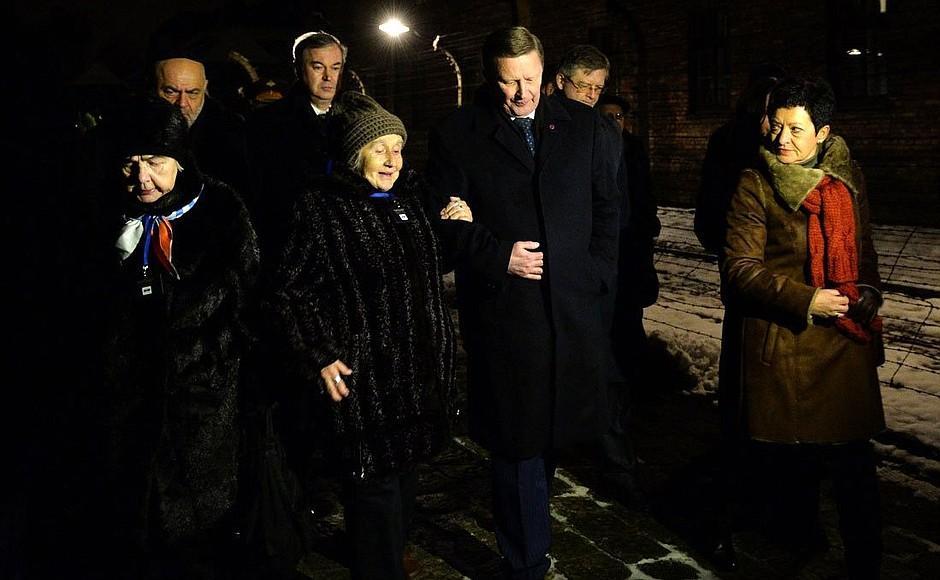
On the 27th January, 1945 Red Army troops liberated Auschwitz concentration camp. The Second World War was drawing to a close, and as Nazi forces were on the verge of defeat, they tried to conceal their crimes. They evacuated the remaining prisoners, destroyed the gas chambers and crematoriums and dismantled the warehouses where those who had died from starvation and disease were corralled. Despite their vain attempts to erase it, the Soviets still managed to reveal to the rest of the world the brutal and inhumane realities of the Nazi project.
The Auschwitz liberation helped to uncover the worst atrocity of the twentieth century. Since then, the world has paused to remember the Holocaust at every anniversary. It is vital that we continue to do this, we owe it to the six million Jews who were murdered. We must always keep them in our memories. We must never forget, because it negates our collective humanity if we simply banish their existence as a mere footnote in history.
Dehumanisation was a central tenet of Nazi ideology. The Jews, in their twisted minds, were not human beings. They did not even consider them to be as lowly as animals, they actually believed that they were a disease. In the propaganda materials they portrayed them as a virus that was infecting European civilisation, and eradicating them was the only cure. It is horrific that such views were countenanced, it is even worse realising that their genocidal plans were enacted.
This sickening act of mass murder is forever emblazoned upon our memories, footage of the concentration camps was captured on news reels and broadcast to the British population after the end of the war. We were convinced that the years of privation were worth it, if it meant securing a victory of good over evil.
When British troops liberated the camps of Bergen Belsen, it left an indelible impression. Many of the young men who saw such levels of degradation and inhumanity were haunted for decades afterwards and could never speak about something, which by its own definition is unspeakable. One of them who did eventually speak was the actor Dirk Bogarde, who wrote extensively in his autobiography about his wartime experience.
Bogarde states that, “when we opened up Belsen Camp, which was the first concentration camp any of us had seen, we didn’t even know what they were, we’d heard vague rumours that they were…The gates were opened and then I realised that I was looking at Dante’s Inferno…I still haven’t seen anything as dreadful. And never will. And a girl came up who spoke English, because she recognised one of the badges…and her breasts were like empty purses, she had no top on, and a pair of pyjamas, and no hair…She gave me a big kiss, which was very moving”.
Shortly after this encounter, the girl died.
Sadly, the Holocaust is dwindling in importance year after year and increasingly relegated as yet another part of history. My generation has grown up understanding that this is more than history, because our grandparents endured the war years. They were our only living connection to this dark episode in human history. Younger generations have no such connection, and it often appears meaningless to them.
Tragically the Holocaust is considered simply a far off event, rather like the Boer war would have appeared to my peers. A distinction needs to be made though, between other wars in history and the Holocaust. The Holocaust was in fact, the culmination of modernity, where society had chosen to forget that we are all one human race.
Society had chosen to forget this, because selfishness had triumphed. Amidst the horrors that unfolded during the war, Pope Pius XII pleaded to those bewitched by Hitler to heed the words of the Bible. He referred to the Book of Genesis which proclaimed that all humanity has a common origin, and all of the people on Earth had a duty to be charitable to one another. His pleas were eventually drowned out by the persuasively manipulative campaign of the Nazis.
Another pitifully modern development is the increasing trivialisation of the Holocaust. This is something which has been utilised by malign political forces. It is a perverse method of moral inversion, and subversion. The most egregious examples occurred in the aftermath of the October 7th attacks when Hamas terrorists committed a pogrom in Israel.
When Israel valiantly defended itself, the efforts to eliminate a racist, genocidal threat to its very existence were undermined. They were even accused of committing genocide themselves. These accusations are deeply hurtful, and belittle the memory of those who were the victims of an actual genocide.
The Holocaust was an industrial level murder machine. It was a deliberate and intentional act, aimed at an entire people. It is true that there have been conflicts and atrocities in various parts of the world since 1945, but nothing of this level in western Europe since, so it is outrageous that words like “Nazi” and “fascist” are flung about whenever difficult political issues are contested. These words have been diluted, and their original meaning has been lost.
It is a bitter irony that the individuals who use these words as insults have more resemblance to Nazis and fascists. These individuals attend marches denigrating the world’s only Jewish state, and argue that alternative political voices should be silenced. It is clear now more than ever that we understand what actually happened in history, to honour the memory of those who suffered and died.
 Ponderings