Tag: horror

  • Prometheus Found

    On the 30th August, 1797 the English author Mary Shelley was born. Her parents, William Godwin and Mary Wollstonecraft, were radicals and intellectuals standing on the cusp of a new world. It was the first stirrings of “the Enlightenment”, a rapidly progressive age of cultural, scientific innovation and political change. Europe was soon convulsed by revolution and counter revolution. The old certainties were waning and dramatically new ideas were emerging in their place.

    It was also a fraught and uncertain time in history. Ideas were perceived as dangerous, treasonous, heretical or blasphemous but amidst danger there was a groundswell of hope. The changing social and political fortunes in France provided vital succour to intellectuals and artists who observed that dictatorial systems could founder and fairer, more equitable societies were possible.

    However the French Revolution was not seamless, and despite the hopes and aspirations of the newly liberated people it quickly descended into anarchy and violence. It seems ironic to reflect that a political system that was supposedly driven by reason eventually transformed into an arena of chaos.

    The violence and terror that was unleashed did not deter luminaries in this country from championing their cause. The “Lunar Society” in Birmingham were prominent supporters, as a collective of scientists and philosophers they had great sympathy with the grand ambitions of the French revolutionaries.

    The British public, however, were not so enamoured by them and their presence provoked riots. When a celebratory dinner was held to mark the anniversary of the fall of the Bastille, rioters broke into the house of Joseph Priestley and set fire to all of his furniture and books.

    The riots continued for a week. Rioters daubed “Church and King for ever” on the walls. The continent of Europe was disintegrating, and there were genuine fears that the same devastating scenario would be replicated in England. Edmund Burke was one of the first to sound the warning bell. He outlined his many objections in a remarkably prescient letter to the Jacobite politician Lord Bolingbroke, written in 1757.

    Burke’s words were prophetic, and it is incredible that he had enough foresight to realise what could happen in a post-revolutionary society. Utopia was a foolish pipe dream. He explains it all in startlingly lucid and convincing prose, clearly stating that “I have sometimes been in a good deal of doubt, whether the creator did ever really intend man for a state of happiness. He has mixed in his cup a number of natural evils (in spite of the boasts of stoicism they are evils) and every endeavour which the art and policy of mankind has used from the beginning of the world to this day, in order to alleviate, or cure them, has only served to introduce new mischiefs, or to aggravate and inflame the old”. Decades would pass before anyone took his warnings seriously.

    In the meantime, scientists and philosophers continued in their ceaseless quest to perfect human society. It was met with a combination of admiration and scepticism. Coleridge was unimpressed, in spite of the initial enthusiasm expressed by his contemporary poet Wordsworth. He seriously doubted the claims made by these learned men and in a letter to him, he complained vociferously that the notion that, “Man’s having progressed from an Ouran Outang state is contrary to all history, to all religion, nay, to all possibility”. Such cynicism was common. However a young poet named Percy Shelley was inspired by the bold theories presented by the scientists and thinkers.

    According to literary legend, Shelley recounted these alarming scientific discoveries to his wife on that stormy evening on Lake Geneva when the assembled guests of Lord Byron were challenged to conceive ghost stories. Mary Shelley, haunted by the notion that life could be manufactured by godless scientists with supernatural ambitions, was stricken with a nightmare. In her diary she remembered this dream of “a pale student of unhallowed arts kneeling beside the thing he had put together. I saw the hideous phantasm of a man…It was on a dreary night of November, that I beheld the accomplishment of my toils. With an anxiety that almost amounted to agony, I collected the instruments of life around me that I might infuse a spark of being into the lifeless thing that lay at my feet”. Now we recognise “Frankenstein” as the embodiment of science divorced from human ethics, the personification of a mortal man believing himself to have Godlike powers. This novel continues to resonate today.
  • Dark Horse

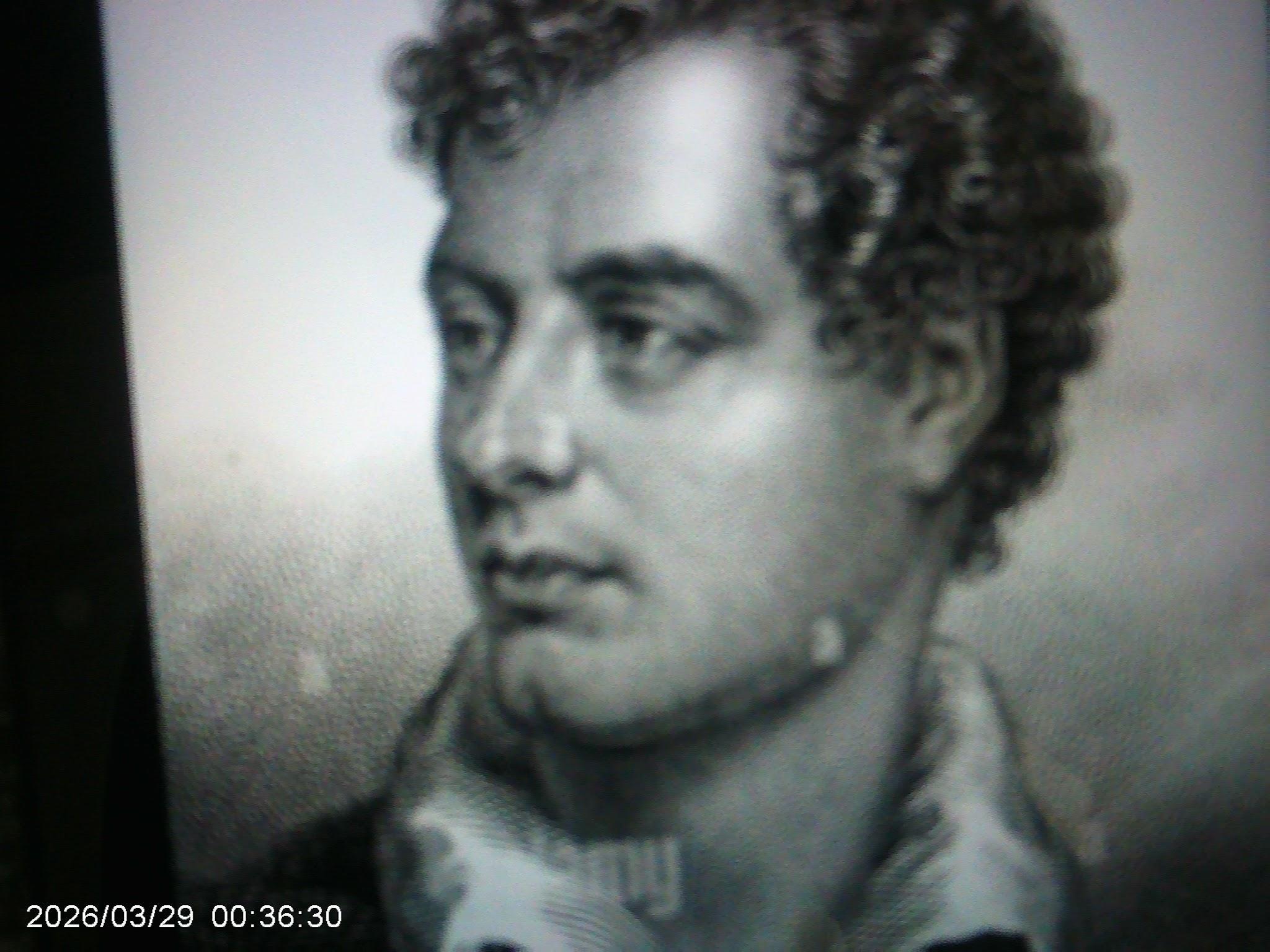
    On the 19th April, 1824 the English poet Lord Byron died. He left an enduring poetic legacy, but also a dark reputation, both historically and culturally. Byron became a legend and a kind of totem for a new and startling epoch. The Romantic age was signified by its individualism, and its cast of unique characters. Mary Shelley’s novel “Frankenstein” symbolises this, the narrative and characterisation almost mirrors the life and times of Byron. Byron was the bete noir of the English establishment and in the wake of scandal was exiled to the far fringes of Europe. Byron personified the louche sensibilities of the aristocracy. His behaviour demonstrated all of the worst characteristics associated with the upper echelons. He was libidinous and profligate with money.

    He represented amorality, and displayed the kind of behaviour that fuelled widespread resentment, but in particular within the lower echelons of society. While banished to a remote corner of the continent, he attempted to restore his literary reputation. He was accompanied by his personal doctor, John William Polidori. On that stormy weekend Byron devised a test for his friends and fellow literary luminaries; he wanted to discover who could tell the best ghost story.

    Dr. Polidori presented an early version of his story “The Vampyre”, the first prose piece of a legend only evinced in poetry. This mythic creature was also unearthly and immortal, and in Polidori’s imagination an alter ego of Byron himself. This was the first example of a “Byronic” figure before this term had even been coined. It is now such a familiar literary trope that we often fail to remember the origin. The Vampire is high born and has an impressive intellect, he is also tremendously alluring and amorous.

    In the story, a young man called Aubrey is intrigued by the presence of a strange and enigmatic figure called Lord Ruthven and the unsettling infamy entwined within the character. Ruthven’s powers are legendary but they are also terrifying, which Aubrey encounters when he meets him in Rome. He leaves under a cloud, but Ruthven’s presence continues to haunt him. This story was a formative and important influence on the Irish writer Bram Stoker, who regenerated this theme nearly eighty years later.

    “Dracula” is a new European reanimation of Ruthven, transmogrified into a dapper and urbane Count inhabiting a ghostly castle, rumoured to be the seat of Romanian aristocrats. This remnant of a palace is situated amidst the misty Transylvanian mountains. The trope is revived once more. The vampire seeks the vitality of youth and draws blood to remain immortal, and in the process ensures that the host also remains immortal. However this vampire story was simply a clever version of an old folk legend and not particularly shocking nor surprising.

    However the world was undoubtedly disturbed and shaken by the unique and unforgettable creature created by Victor Frankenstein. It is a testament to Shelley’s originality and literary brilliance that her work had a much greater and wider cultural influence, and legacy. “Frankenstein” subtitled “The Modern Prometheus” subverted all of the conventions and mores of the age.

    All of the characters imagined on that stormy night were Promethean figures. This was an entirely new concept of the Romantic era. They imagined characters imbued with superhuman and supernatural powers, defiantly challenging the natural order with their quest for omnipotence. Romantic literature exposes the flaws of the human ego when it is left unchecked. The romantic poet is a fragile figure, forced to play an unnatural role in a world of artifice. He is a ghostly presence in an arena that demands authenticity and spurns pretension.

    Ghost stories themselves are allegories, designed to illustrate transgressive or repressed sexual desires. This theme resonates throughout “Frankenstein”. There is an all pervading sense of sexual repression, a blight upon the age. The notion that an immortal being could be created and then given life by a mad scientist was in itself a shocking concept.

    However Frankenstein manufactured an unearthly and ageless being, utilising the tools of science. It was an entirely artificial construction devoid of original sin and in his own godlike vision it was a creature destined to supersede the follies of mortal men and eventually transcend death itself. Frankenstein himself does not feel ashamed that he has meddled with nature. He only feels a sense of enormous personal achievement, as the inventor of an entirely new kind of creature, one that will never die.

    His delusions of grandeur render him a secular deity, entirely detached from the historical and clerical foundations of European civilisation. Imagining a creature that is neither dead nor alive in the conventional sense is now a familiar literary trope, but it was an innovative idea for the time. This was a time of political foment on the continent, particularly in France.

    In spite of growing alarm in Britain, the antics of the French revolutionaries left a trail of devastation. They were defiantly and belligerently anti-clerical and looted the churches and monasteries. It was a repudiation of the proud legacy of religious women who raised the status of women after the indignities of Pagan Rome. They had chosen to devote their lives to Christ for centuries, until the revolutionaries forced them to relinquish their property and divest themselves of their visibly religious status. In 1794, 16 Carmelite nuns refused to surrender to them and they were arrested and put to death. Each nun approached the guillotine in calm defiance singing a hymn to the Holy Spirit, their voices silenced by the sound of the blade. It was a scene of true courage.

    Percy Shelley was another louche scion of the aristocracy. Shelley also had Byronic characteristics. He too, was profligate, promiscuous and almost by default, intensely alluring to women. The young Mary Godwin was just one out of many young women who had fallen under his spell. Their alliance was scandalous, and they too were exiled to Europe. Yet Europe was unfamiliar, strange and detached from civilisation. It was a continent that would be torn apart by the Napoleonic wars. The Faustian spirit that inspired the greatest art and literature also contained the seeds of its own destruction.