Tag: ireland

  • The Magic Mountain

    The 17th March is St. Patrick’s Day, the Patron Saint of Ireland. It is an annual celebration of Ireland, Irish history and culture. It is marked with festivities within Ireland and throughout the global Irish diaspora. Originally it was a solemn religious occasion. However in modern times the focus has been on the secular and cultural aspects of Ireland.

    The legend of Patrick is closely entwined with Ireland and the Irish people, but he was originally from Britain. When he was just seventeen years old he was snatched from his family by Irish pirates and he was taken to Ireland where he was kept in captivity as a slave.

    Fifth Century Britain was left in a vulnerable state after the collapse of the Roman Empire. The ancient Celtic Kingdom of Ireland had a distinct reputation, and it was regarded as a notorious place known for its warriors and pirates. Irish pirates frequently raided the coasts of Great Britain looking for slaves. Patrick was just one out of numerous victims of these raids, another was St. Brigid who is also revered as a sacred figure in Ireland. These incursions were more than likely opportunistic. There is no evidence to suggest that their actions were motivated by malice or that they were attempting to further humiliate or subdue an already demoralised population.

    Patrick worked as a slave for six years, tending sheep on a farm and praying for his own emancipation. However after six years he received a message from God telling him to return home, and that a ship was waiting for him. He escaped to the coast and persuaded the captain and the crew of a passing ship to transport him back to Britain. However as soon as they arrived they found a wilderness. Patrick urged them all to put their faith in the Lord. The power of prayer saved them, as a herd of wild boar suddenly appeared. This miracle made Patrick an enamoured figure among the group.

    Patrick spent years studying theology, in Britain and across continental Europe. He was ordained at Auxerre, and eventually progressed to the Bishopric. However he had not forgotten his early life in Ireland. Despite his difficult experience he felt a degree of affection for the culture, as his captors introduced him to the myths and legends of Ireland. It was while he was stationed back in Britain that he received another vision summoning him back to Ireland. It was a divine message imploring him to evangelise the pagan population.

    When he returned to Ireland as a missionary he encountered individuals with profound and enduring attachments to the old beliefs. They remained stubbornly resistant to the Catholic creed and refused to practice the necessary rites. The worship of nature was ingrained instead, and they paid homage to other gods.

    However Patrick found ingenious ways to accommodate them. He had a great insight into the Irish psyche and how magic and miracles were deeply embedded within the national consciousness. Patrick’s ministry only served to strengthen these sensibilities.

    Patrick had immense strength, courage and faith even when the pagan population were determined to kill him. On one occasion when his life was in great danger, he knelt before his antagonists and prayed to God for help to convert their souls. His prayers were so fervent that when he rose to his feet the mark of his knees were still imprinted on the ground. Another time he told the villagers to draw a circle around them, and as he prayed, water instantly sprung from the ground and they were all baptised.

    Superstition and mysticism was all around him. One of the most powerful myths relates to a giant serpent, believed to be situated close to the Galtee mountains. Patrick knew that the locals revered serpents as gods, but he cast this serpent into the lake and made a plea that this serpent remained chained to a rock until the Day of Judgement. Patrick was also believed to have cast all venomous creatures from the island of Ireland.

    Patrick understood that the people felt awe of the natural world. The Temple of Tara in County Meath is popularly believed to be the resting place of an ancient semi-divine King. Another example of a holy mountain is situated on the west of Ireland, the centre of Patrick’s evangelical work. In pagan Ireland, pilgrims would ascend to the top of the mountain to mark the summer solstice. Fruits would be offered to the gods, a bull would be sacrificed and ritual dances and plays would be enacted.

    When Patrick served in the region he learned about the mountain’s reputation and so he decided to climb to the peak to pray and fast for 40 days. He was assailed by demonic birds, but he banished them into the hollows by ringing his bell. He cleansed the mountain of evil, and released the Irish from their iniquities. The mountain is now called “Croagh Patrick” and it is devoted to Chrstian pilgrimage, rather than pagan devotions. We must remember the important legacy of St Patrick and how he shaped Ireland today.
  • Bonfire Hearts

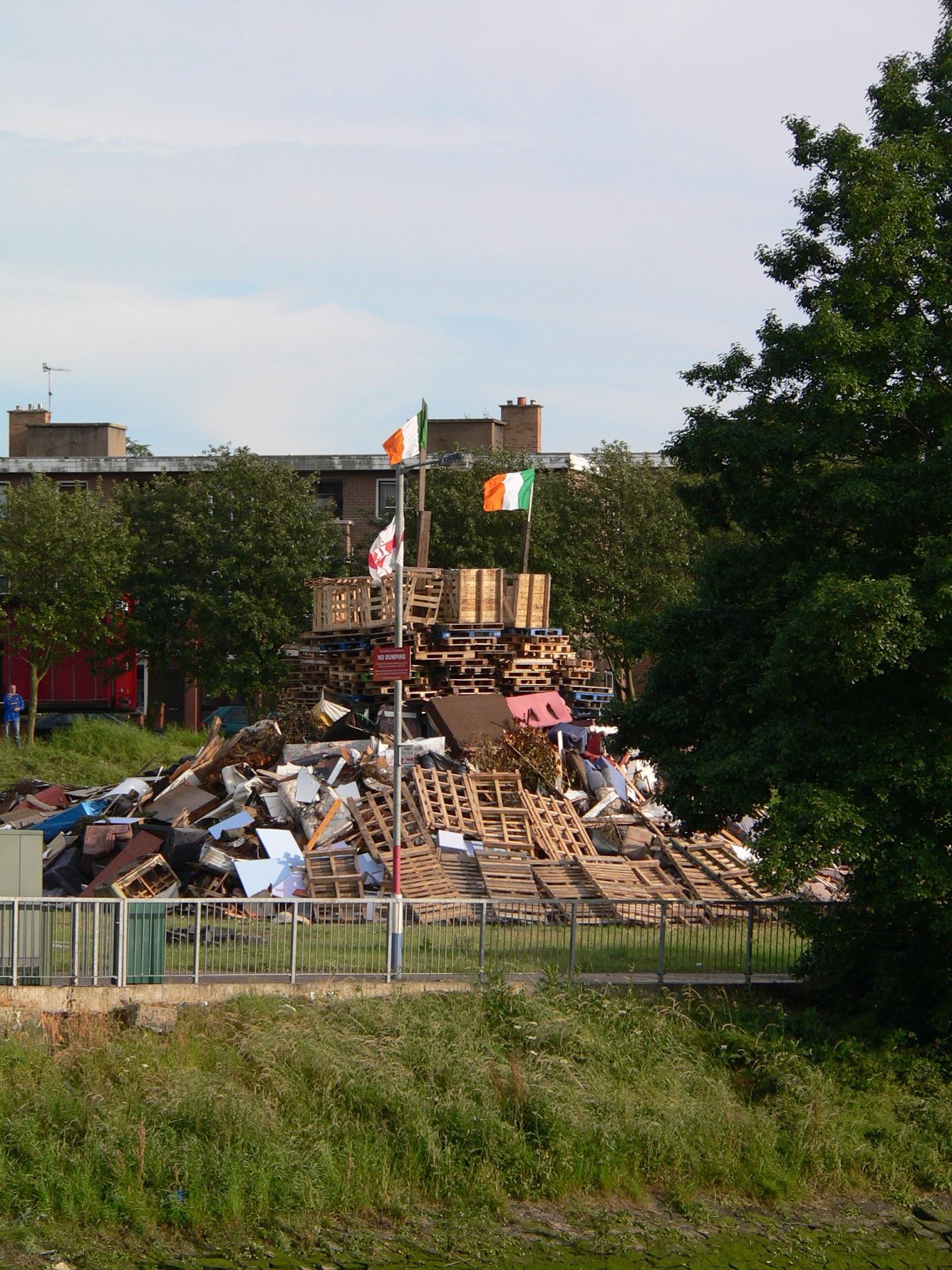
    The 11th of July is a vital and integral part of Ulster Protestant culture, a day in which Unionist communities in Northern Ireland anticipate the “Glorious Twelfth” with the construction of bonfires. It is a tradition, which takes place every year to mark Protestant victory over Catholic forces.

    However it has had a controversial history, and the celebrations have been overshadowed by episodes of sectarian violence, and the threat of Loyalist terrorism. As a consequence, recent attempts have been made to restore the peaceful nature of the festivities, and to emphasise its real meaning. It is a pity that the historical significance has almost vanished in the wake of such malevolence, and the mischief of bad actors with political grievances. This year, contemporary political events have infiltrated the occasion, and almost sabotaged the proceedings.

    However, fifteen years ago, in Belfast concerted efforts were made to depoliticise the event. Bonfire committees were established, in order to maintain peace and to eliminate the divisive nature of some of the eleventh gatherings. They all agreed that burning the Irish tricolour flag was, in a literal sense, far too incendiary, and the display of Loyalist symbols and flags actually spoiled the commemorations.

    Belfast council later acknowledged that it was important for the community to gather together to celebrate their heritage and culture, but not at the expense of others, especially Catholics who do not share the same beliefs.

    The precarious state of Northern Ireland, and the ambiguity that prevails with its relationship to its Southern neighbour, and indeed with its tenuous relationship with the rest of the United Kingdom has been a source of contention since its inception a hundred years ago.

    A sense of mistrust has ebbed and flowed over intervening years. It is a tremendously emotive subject, as religious and cultural ties are not so easily severed. People will always remain attached to their beliefs and religious feelings. There is a strong sense of affection and loyalty, so loosening the knot is unthinkable.

    These deeply held sentiments are profound, even though outsiders will inevitably observe the situation differently. The people of Northern Ireland are in a double bind. Superficial reports paint them in an unfair light, as religious bigots, or warring tribes with no hope of reconciliation. It only suits the politicians to diminish people in this reductive way, but does not help the future of the union in the long term, or indeed its future in relation to the rest of Europe.

    However, the delicate and fragile peace that has been maintained for some decades is not a given, it has evolved and it was a huge sacrifice, both literally and metaphorically. This is not a new situation. This is a union that has been forged over 600 years. It is the foundation of our constitution, and it is the reason why the United Kingdom is unique as a sovereign entity. It is also the reason why the UK as a state distinguishes itself as separate from Europe, both politically and culturally. Unlike the volatile continent, the UK sought to conciliate, rather than antagonise. This has not been easy or smooth, uniting four distinct nations under one sovereignty has over the centuries been an almost impossible task.

    This was evident during the English Civil War. Basically, this was a conflict between two autocrats, both of whom professed that their religious and political authority was correct. Rebellion in Ireland ensued. This was vicious and bloody, leaflets from that time opined that “we have waded too far in that crimson stream (already) of innocent and Christian blood”. Unfortunately the bitter legacy of that time is still fresh in the memory of Irish people today, and many of them are too aggrieved to forgive and forget.

    Cromwell was eventually victorious, but his short-lived experiment as Lord Protector of the Commonwealth merely replaced the tyranny of the King with a new kind of despotism. The Monarchy was restored in 1660, but the Kingdom was a pale shadow of its former glory. The power of Parliament, in the face of absolutism had also waned. There were fears that enmity would rise again against the Crown.

    The last four years of King Charles II reign were autocratic, as he ruled without the interventions of Parliament. He was fortunate enough to receive the financial support of his cousin, the French King Louis XIV. Throughout these years the United Kingdom remained passive in the face of French ambition. After Charles’ death, his brother James ascended the throne. James’ Catholicism was more overt than his predecessor, and there were hints that he wanted to emulate King Louis’ absolutist style of rule.

    James’ illegitimate son, the Duke of Monmouth was living in political exile at the time of his father’s accession. Ensconced in the safe company of his allies in Holland he hatched a plot to dethrone the King and proclaim himself the rightful heir. His comrades and fellow conspirators were political refugees from the Whig party who fled when their previous plan to prevent Charles’ accession failed. They severely underestimated the might of their adversaries in the Tory party and were banished.

    Monmouth led a fleet of three ships containing eighty-three men to the shores of Lyme Regis in Dorset. This was the seat of English Republicanism and was renowned as a stronghold of dissenting Protestantism. He pledged that he would release the Kingdom from the “Absolute Tyranny” that was put in place by his uncle. Three thousand men from Lyme Regis joined him in his crusade against the forces of Catholicism.

    However these men were no match for the King’s Army. 500 were killed and 1,500 were imprisoned. The Duke managed to escape by disguising himself as a shepherd. Two days later he was discovered in a ditch, and he was summoned to London to face the King. He was charged with treason and executed at the Tower. The Duke became a martyr for the cause. The urgency of the cause became more pressing after King Louis reversed the Edict of Nantes, a law designed to prevent the persecution of French Protestants.

    The diarist John Evelyn recounted the effects of this reversal, stating,

    “The French persecution of the Protestants raging with utmost barbarity…The French tyrant abolishing the Edict of Nantes…and without any cause on the sudden, demolishing all their churches, banishing, imprisoning, sending to the galleys all the ministers, plundering the common people and exposing them to all sorts of barbarous usage by soldiers sent to ruin and prey upon them”.

    Parliament was recalled, as a new constitutional crisis appeared on the horizon.

    It soon became clear that James did seek absolute power, and to undermine the Protestant cause to re-establish the Catholic Church as the official religion of the country. It was fortuitous that James’ daughter was married to the Dutch King, William of Orange. William had more persuasive powers than Monmouth, and he was alarmed by the antics of Louis. He was afraid that the whole of Europe would fall under his absolute rule, and the freedom of religious conscience would be sacrificed.

    William’s English supporters sent him an invitation to enter the Kingdom. His arrival, in Brixham on the 5th November 1688, set in motion a chain of events known as “The Glorious Revolution”, when James was forced to relinquish his position and accept that William was the legitimate King of a free and democratic Kingdom. However this was not acceptable to the Catholic subjects in Ireland, who were loyal to James. They were known as Jacobites, and they resisted his authority. It led to an all out war, but the Orange cause was victorious in spite of the money that was lavished on the Jacobite Army by the French King.

    Today “Orangemen” continue to pay tribute to the man who helped to liberate them from religious tyranny. It is a continuing cause of celebration in Northern Ireland, but it is regarded with ambivalence in the Republic of Ireland. The Irish Republic was supposed to be a democratic, secular state, nominally Roman Catholic, but still hospitable to the minority Protestant population.

    However the fate of the Republic did not turn out in the way it was envisaged, the Catholic Church actually dominated society. The years of religious tyranny appeared to be returning with a vengeance. The veteran Irish writer John Banville opined,

    “The war of independence and the civil war were disastrous for us. The bad people took over. The partition took away that Protestant dissenter tradition and the 26 counties were left to the priests”.

    This was noticed by large swathes of the population. However the Republic of Ireland has evolved into a more secular state. Consequently attitudes towards their Northern neighbours have softened.

    There is a faint possibility that the historical achievements and contributions of Protestants will finally be acknowledged, not just in Ireland but in Great Britain as well. I hope that a proportionate and balanced view of history will prevail.